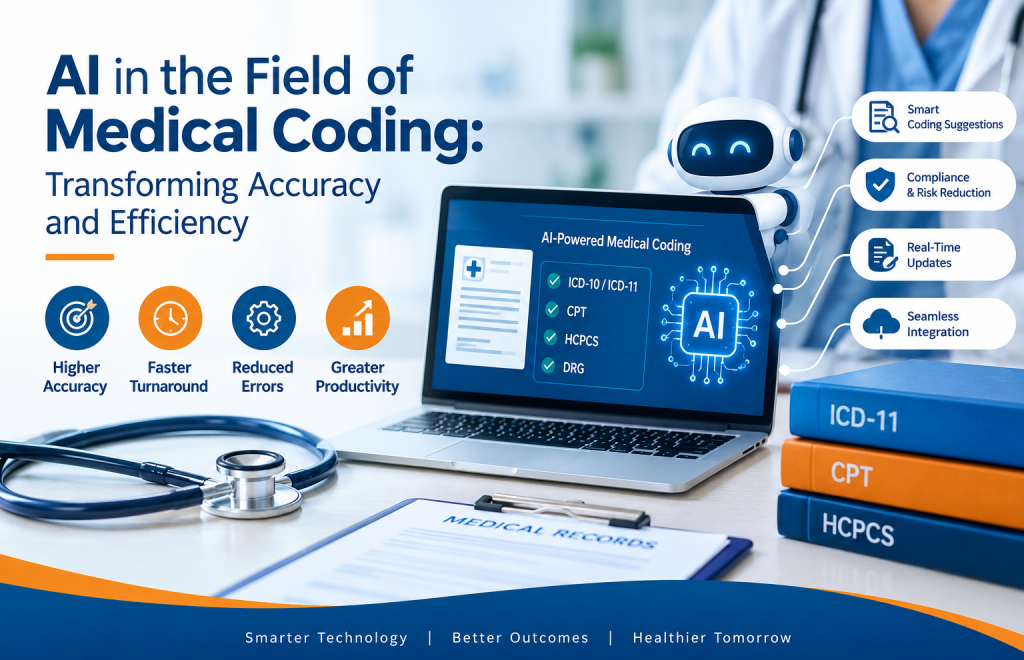
In a tech-savvy cosmos, Artificial Intelligence (AI) is rapidly transforming healthcare by helping organizations manage information more efficiently. AI is aiding to improve decision-making and deliver better patient care. One genre where AI is creating significant opportunities is medical coding.
Traditionally, medical coding has relied heavily on the expertise of professional coders who review clinical documentation and assign standardized codes for diagnoses, procedures, and services. With the gradually increasing volume and complexity of healthcare data, AI-powered solutions are now assisting coders in working faster while maintaining accuracy and compliance.
What Is AI in Medical Coding?
When it comes to utilizing AI in medical coding, it usually refers to the use of technologies such as machine learning, natural language processing (NLP), and intelligent automation to analyze clinical documentation and identify relevant medical codes.
Artificial Intelligence can carry out in-depth analysis of data from electronic health records or EHRs, physician notes, discharge summaries, operative reports, and other clinical documents. This system can seamlessly recognize medical terminology, identify diagnoses and procedures, and suggest appropriate ICD, CPT, HCPCS, or other applicable codes.
Rather than completely replacing medical coders, AI is increasingly being used as an intelligent assistant that supports coding professionals in their daily activities.
How AI Is changing the medical coding process
Traditional medical coding practice can entail manually reviewing lengthy medical records to identify relevant clinical information. This can be time-consuming, particularly when documentation contains complex medical terminology or multiple diagnoses.
Whereas using AI can analyze large volumes of documentation in a short span and, at the same time, highlight information that may be relevant for coding. For example, an AI-powered coding solution can identify a documented diagnosis, recognize its clinical context, and suggest a potential code for the coder to review.
This generates a human-in-the-loop approach, where this technology performs repetitive analysis while experienced coders provide the final validation and decision-making.
Enhancing coding accuracy
One of the most crucial merits of AI in medical coding is its potential to enhance accuracy. Before upgrading accuracy, it is pertinent to understand why coding errors occur. It’s usually because of incomplete documentation, missed diagnoses, inconsistent interpretation, or the complexity of coding guidelines.
AI tools can properly scan documentation systematically and identify relevant details that might otherwise be overlooked. They can also flag potential inconsistencies, missing information, or documentation that requires further review.
However, AI-generated suggestions still need appropriate human oversight. Medical coding contains clinical judgment, coding-related guidelines, payer requirements, as well as documentation interpretation. Professional coders remain essential for reviewing and validating AI recommendations.
Increasing coding efficiency
Medical coding departments of any healthcare facility often manoeuvres huge chunk of records, making productivity a crucial consideration. Discussing AI, it can automate repetitive tasks and reduce the amount of manual searching required by coders.
For example, AI driven systems can quickly extract diagnoses, procedures, medications, along with other relevant clinical data from documentation and process the same. Instead of spending significant time searching through records, coders can focus their attention on reviewing AI-generated suggestions and handling complex cases. This can effectively reduce coding backlogs.
The role of Natural Language Processing
Natural Language Processing, or in short NLP is one of the pivotal technologies behind AI-powered medical coding. Healthcare documentation is often drafted in natural language rather than structured coding terminology.
NLP makes sure AI system understands and interprets clinical language correctly. This technology identifies medical concepts from physician notes and other documentation. It connects those concepts with standardized coding terminology.
AI and clinical documentation improvement
When it comes to Clinical Documentation Improvement (CDI), AI can work as a perfect aid. AI-powered systems can critically analyze records to identify potential documentation gaps or inconsistencies. These findings can help coding and CDI teams determine whether additional clarification may be needed from healthcare providers.
Better documentation can support more accurate coding, enhance data quality, and provide a clearer representation of the patient’s clinical condition.
Reducing administrative work
Medical coders spend considerable time on repetitive activities such as searching documentation, reviewing terminology, and navigating coding references. AI can automate portions of these tasks precisely.
By reducing repetitive administrative work, this particular technology allows coding professionals to dedicate more time to complex cases that require expertise and judgment. This can make the overall workflow more efficient while allowing organizations to make better use of their coding workforce.
Challenges of AI in medical coding
Despite immense merits, AI adoption in medical coding comes with certain challenges. Healthcare documentation can be highly complex, and clinical language may contain abbreviations, obscure statements, or context that is rigorous for an automated system to interpret.
AI models can also produce incorrect recommendations. Therefore, organizations should not treat AI output as automatically correct.
Apart from the above, other challenges comprise system integration, staff training, data quality, algorithm transparency, and keeping AI systems aligned with changing coding guidelines and healthcare regulations.
The future of AI-assisted medical coding
The future of medical coding is likely to involve closer partnership between AI technology and skilled coding professionals. With proper utilization and also as AI systems become more sophisticated, with gradual passage of time they may cater increasingly accurate code suggestions, prioritize complex cases, and identify potential documentation or compliance issues.
The role of medical coders may gradually evolve from primarily manual code selection toward reviewing AI recommendations, resolving complex cases, interpreting documentation, and ensuring coding quality.
Conclusion
AI is bringing a new level of intelligence and automation to medical coding. It may be analyzing clinical documentation and suggesting codes to distinguishing potential errors and enhancing workflow efficiency, AI can support healthcare organizations in managing increasingly complex coding demands.
However, the future is not simply about replacing human coders with machines. As healthcare strives to flourish as more digital and data-driven, the combination of AI, skilled medical coders, and strong quality processes can help develop a medical coding environment that is seamless, faster, agile, more accurate, scalable, as well as effective.

