
In the contemporary, rapidly evolving healthcare ecosystem, healthcare providers face more pressure than ever. Swindled reimbursements, rising administrative workloads, along with frequent coding updates, as well as increasing compliance demands, are prompting healthcare organizations to reassess their methodology for managing revenue cycle operations. One strategic shift that is gradually gaining strong momentum is outsourced medical coding.
This process, once observed as an optional cost-cutting measure, outsourcing medical coding has now become a performance-driven decision for hospitals, clinics, and specialty practices. Let’s now take a quick look at the top reasons why healthcare providers are making the switch.
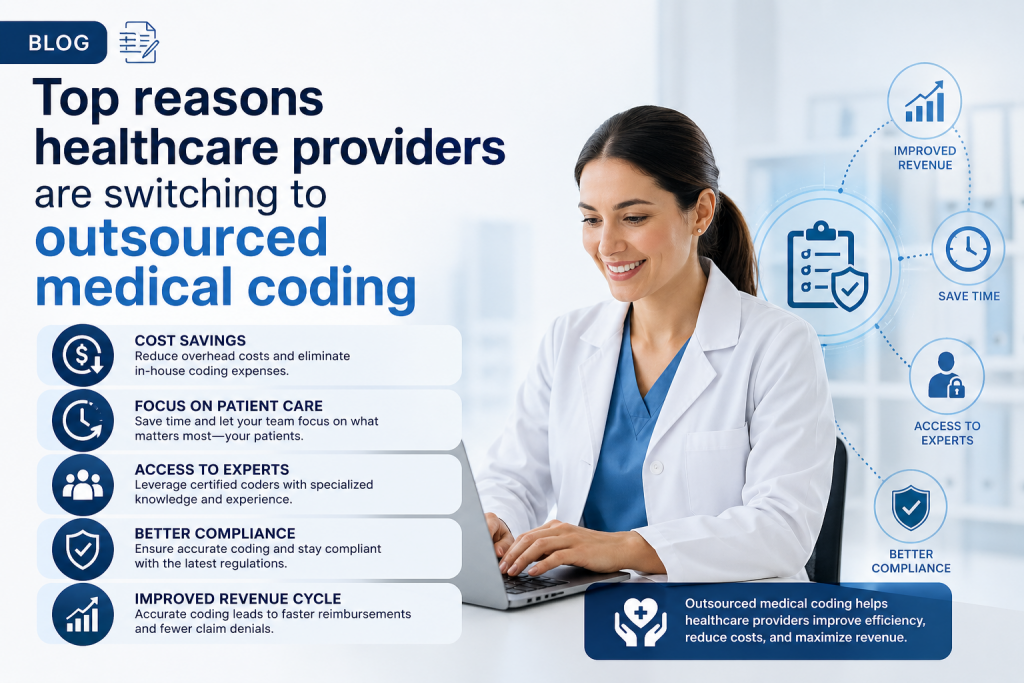
1. Growing complexity of medical coding regulations
With the advent of ICD-10-CM, CPT, HCPCS, and payer-specific guidelines, the genre of medical coding is constantly evolving and is no longer a straightforward task. Even experienced in-house teams struggle to stay up to date. A single coding error can lead to claim denials, delayed reimbursements, and other compliance-related risks.
Outsourced medical coding partners specialize exclusively in coding. Their teams receive continuous training on regulatory updates, payer policies, and specialty-specific requirements—ensuring accuracy, compliance, and peace of mind for providers.
2. Rising operational costs of In-house teams
If you are planning to sustain an in-house coding department, it can entail significant expenses, comprising staff salaries, other perks, recruitment, training, infrastructure, as well as ongoing education. Add to that the challenge of coder turnover, and the financial burden becomes even heavier.
When it comes to outsourcing, it converts fixed costs into scalable operational expenses. A client company gets the opportunity to pay only for the services they actually require, without worrying about staffing shortages or overhead—making it a more cost-effective, agile, and also predictable solution.
3. Faster turnaround times and enhanced productivity
If, by any chance delay in coding happens, it can directly affect billing cycles along with cash flow. In-house teams can often face backlogs due to staff shortages, holidays, or sudden spikes in patient volume.
Whereas outsourced medical coding teams seamlessly operate with round-the-clock productivity models, making sure faster chart turnaround as well as timely claim submissions. This results in enhanced revenue velocity and a reduction in accounts receivable (AR) days.
4. Reduced claim denials and rejections
Why do claim denials happen? Coding inaccuracies remain as one of the leading causes of claim denial. Even if minor errors occur, such as missing modifiers, incorrect diagnosis codes, or under-coding, it can cater a significant impact on reimbursement.
Professional coding service providers strictly follow quality assurance along with audit protocols, often achieving higher first-pass acceptance rates. By minimizing denials and rework, providers see a noticeable improvement in clean claims and overall revenue performance.
5. Availing access to certified and specialized coders
If you are trying to hire and retain certified coders like CPC, CCS, or specialty-specific coders, it can become a stressful and difficult task due to high demand and limited talent pools.
Whereas opting for outsourcing partners can cater instant access to highly certified and professional coders with deep expertise across multiple specialties, comprising of orthopedics, cardiology, oncology, DME, along with behavioral health. This helps in accurate documentation capture as well as optimized reimbursement without internal hiring challenges.
6. Enhanced focus on Patient Care
Patient care is of prime importance. Healthcare providers’ main job role is to care for patients and not to navigate administrative complexities. Yet coding and documentation demands often pull clinical and administrative staff away from patient-centric activities.
By outsourcing medical coding services, facilities can free up internal teams to focus on other areas like clinical excellence, patient engagement, and operational improvements. The result is better patient experiences and reduced provider burnout.
7. Enhanced compliance and risk management
Audits, penalties, as well as compliance violations can lead to serious financial and reputational consequences. It is highly essential to maintain compliance with HIPAA norms, payer audits, along with documentation standards requires ongoing vigilance.
When it comes to hiring a professional coding venture or service provider, they do prioritize compliance, data security, and audit readiness. Many service provider goes through layers of quality checks, internal audits, and compliance frameworks to mitigate risk and safeguard their provider operations.
Outsourced medical coding is no longer just a prudent solution—it’s a strategic advantage. As healthcare regulations grow more complex and financial margins tighten, providers are turning to specialized coding partners to streamline operations, reduce risk, and strengthen revenue performance.
For organizations aiming to stay competitive, compliant, and patient-focused, outsourcing professional medical coding services can prove to be a smart and future-ready choice.

